

Graceville Commission Discusses Employee Pay During Budget Workshop


The Graceville City Commission met Thursday, September 3, for a detailed review of the city’s proposed 2026-2027 budget, with one of the most extensive discussions of the workshop centered on employee compensation and whether the city should move forward with a proposed three percent across-the-board cost-of-living increase or consider a flat hourly increase instead.
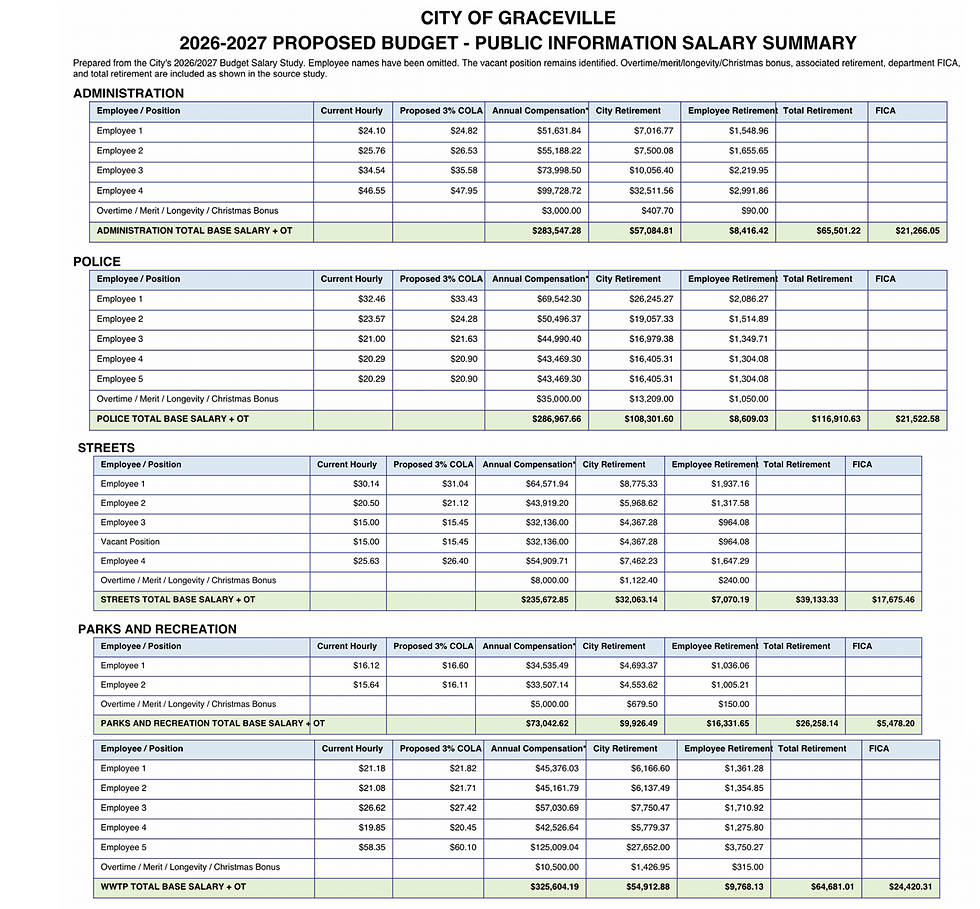
The proposed budget includes a three percent cost-of-living adjustment for city employees. Because salary increases also affect the city’s required contributions for retirement and other personnel expenses, commissioners discussed both how the proposed increases would affect individual employees and the overall cost to the city. Commissioner Samantha Angerbrandt questioned whether using the same percentage increase for employees at significantly different salary levels was the best way to distribute the money budgeted for employee raises. Angerbrandt said she supported providing raises to employees but wanted commissioners to examine the difference between a percentage-based increase and a flat hourly increase.
During the discussion, Angerbrandt referenced the city’s salary study and noted that four city employees currently earn less than $20 per hour, including employees earning approximately $15 and $16 per hour. She also pointed to police officers earning near the lower $20-per-hour range and employees in the Street Department. Under a three percent increase, the dollar amount of an employee’s raise increases along with the employee’s existing wage. An employee earning $15 per hour would receive an increase of approximately 45 cents per hour, while an employee earning $20 per hour would receive approximately 60 cents. An employee earning $30 per hour would receive approximately 90 cents, while an employee earning $40 per hour would receive approximately $1.20 per hour. Angerbrandt contrasted those amounts with employees at the upper end of the city’s salary scale, noting that the same three percent applied to higher salaries results in a larger hourly and annual dollar increase.
The discussion also included what commissioners considered a livable wage in Graceville. Mayor Terry Nichols estimated that somewhere in the range of $15 to $20 per hour would generally be necessary, while acknowledging that his estimate was not based on a formal analysis and that individual circumstances vary. When asked whether he believed an individual could live on minimum wage, Nichols said he did not believe one individual could do so. Commissioner Walter Olds noted that the answer would also depend on an individual’s lifestyle and expenses. Angerbrandt said the city should consider whether a flat hourly increase would direct a larger share of the salary increase, proportionally, to employees at the lower end of the pay scale.
The salary discussion also included Police Department staffing and compensation. Angerbrandt questioned whether wages for police officers were competitive considering the responsibilities and risks associated with the position and expressed concern about the city’s ability to retain officers if compensation is not competitive. The proposed 2026-2027 Police Department budget is based on five-and-a-half officer positions, with additional funding included for overtime and merit-related expenses.
City Manager Michelle Watkins explained that an employee’s current base wage does not necessarily reflect all increases an employee could receive during the year. Some employees are relatively new and may receive additional increases after completing probationary periods or obtaining required certifications, while other employees may qualify for longevity or merit-related increases. Any increase in base salary can also affect retirement and other personnel expenses paid by the city. Commissioners also discussed whether the city should eventually establish a more formal compensation structure with defined salary ranges or classifications for positions.
As an alternative to the proposed three percent increase, Angerbrandt proposed that the city calculate the cost of providing employees with a flat 75-cent-per-hour raise. Under that proposal, an employee earning $15 per hour and an employee earning $40 per hour would each receive the same 75-cent hourly increase. As a percentage of current wages, however, the increase would differ. A 75-cent increase would equal five percent for an employee earning $15 per hour, 3.75 percent for an employee earning $20 per hour, 2.5 percent for an employee earning $30 per hour and approximately 1.9 percent for an employee earning $40 per hour. Angerbrandt explained during the discussion that she arrived at the 75-cent figure by looking at the dollar increases generated by the three percent proposal and selecting an amount near the middle of those increases, excluding some of the city’s highest salaries.
Rather than making a decision during the workshop, commissioners asked for additional information that would allow the two approaches to be compared. Angerbrandt asked Watkins to prepare a spreadsheet showing the proposed three percent increase alongside the 75-cent-per-hour alternative. Watkins agreed to prepare the comparison and said retirement and associated personnel costs would also be included so commissioners could compare the total cost of each option. No final decision on employee raises was made during the September 3 workshop.
The salary discussion was one part of a broader department-by-department review of the proposed budget. Watkins reported the city’s certified taxable property value at approximately $118.59 million, with approximately $450,648 in projected ad valorem revenue when collections are budgeted at 95 percent. Officials also reviewed water and sewer revenues and various state, franchise and utility-tax revenues. The city’s special revenue funds declined from approximately $19.5 million to $17.4 million, largely because the approximately $2.2 million grant associated with construction of the new fire station has been completed and closed out. The Fire Department reserve also decreased after insurance and FEMA funds that had been placed in reserve were used toward the new facility.
Street paving was another area of discussion. Watkins explained that approximately $150,000 included for paving is currently serving as a balancing figure within the proposed budget, meaning changes in General Fund expenditures or revenues could affect the amount ultimately available for paving. Watkins said the city began implementing a paving plan several years ago, with work previously completed on the south end of Pelham Court and a portion of Patterson Circle. She said the amount currently budgeted should be sufficient to complete Patterson Circle. The city has also applied for grant funding to pave Pelham and Martin streets but had not received a decision on the application as of the workshop.
The Police Department budget also received considerable review. Officials said sufficient money has accumulated in a dedicated Police Department reserve fund to purchase a new patrol vehicle through the state bid process at an estimated cost of approximately $55,000. Watkins and Police Chief Jason Barley discussed the age and condition of vehicles currently in the department’s fleet, including vehicles that have reached the point where additional repairs may no longer be practical. Commissioners also reviewed approximately $40,000 budgeted for the city’s agreement with the Jackson County Sheriff’s Office for dispatch, CAD, 911 and related services. Watkins explained that operating a compliant local dispatch center around the clock would require approximately three to four dispatchers and would cost significantly more. Other Police Department subscription expenses discussed during the workshop included body-camera services and policy and standard operating procedure services.
The Fire Department budget is expected to increase with the opening of the city’s new fire station because the city will now be responsible for utilities and other operating expenses associated with the facility. Watkins noted that most items in the new building remain under warranty, which could limit maintenance expenses during the first year. At the Civic Center, the city plans to continue renovations by working on the north end of the facility, including bathrooms that require plumbing work before that portion can be more fully utilized for rentals. Approximately $5,500 was discussed for materials, with plumbing expected to account for a significant portion of the work.
The Civic Center’s rental rates were also discussed. Watkins said the current rate is $50 per hour with a three-hour minimum, while qualifying nonprofit organizations receive a reduced rate. The school is permitted to use the facility without charge as a community service. With improvements being made to the building and electricity costs increasing, officials discussed whether rental rates may eventually need to be reviewed.
Water and sewer expenses remained relatively stable overall, although officials discussed the sometimes substantial cost of maintaining the city’s infrastructure. Watkins cited recent work at the Cliff Street bridge during which a 12-inch water main was struck, noting that the valve required for the main cost approximately $6,000. Wastewater treatment expenses are expected to increase primarily because of chemical and electricity costs. The city’s wastewater system also continues to carry debt associated with bonds originating in 1996 and 2001 related to construction of the wastewater treatment plant, along with an SRF loan associated with the installation of higher-efficiency blowers.
Commissioners also reviewed cemetery expenses and equipment needs, the city’s after-hours answering service, reserve accounts and Christmas decorations. Watkins explained that $3,000 budgeted under administration for Christmas decorations is intended for larger decorative items, while another $3,000 in the Street Department budget covers Christmas lights, replacement bulbs and related items. She said the city frequently has to replace lights and that some of the commercial bulbs used in pole decorations are costly.
With several areas of the proposed spending plan still under consideration, commissioners scheduled another budget workshop to continue reviewing the 2026-2027 budget. Among the information expected to return to the commission is the employee compensation comparison requested by Angerbrandt showing the cost and employee-by-employee effect of the proposed three percent across-the-board increase and the alternative 75-cent-per-hour increase. Commissioners are expected to review that comparison as they continue work on the proposed budget.




Comments